Anúncios
That feeling of the walls closing in isn’t just in your head—it’s a reality for millions living in increasingly compact urban spaces. The dream of a spacious home has been replaced by the practical challenge of fitting a full life into a few hundred square feet. But what if this constraint wasn’t a limitation, but an invitation to innovate? The solution isn’t just about owning less; it’s about owning smarter, more adaptable things that work as hard as you do.
This shift toward smaller living quarters is a significant demographic and economic trend. As cities grow denser and housing costs climb, the average apartment size continues to shrink. This has ignited a revolution in home design, forcing manufacturers and consumers alike to rethink the very function of furniture and household goods. The era of single-purpose items is fading, replaced by a demand for products that offer flexibility, efficiency, and style in a minimal footprint.
Anúncios
This guide moves beyond the obvious advice of simply decluttering. We will explore the ingenious solutions redefining small-space living, from multi-functional furniture that transforms a room in seconds to clever vertical storage that reclaims unused walls. We’ll also cover the tech-integrated gadgets that reduce physical clutter and the core design principles that create an illusion of space. Prepare to discover how to make your small apartment not just livable, but exceptional.
The Evolution of Compact Living: Why Space-Saving is required Now
Let’s be honest: the dream of a sprawling suburban house with a white picket fence is fading for millions. People are flocking to cities not just for opportunity, but out of necessity, creating a surge in demand for smaller living quarters. This isn’t just a trend; it’s a basic shift in how we define “home.” The data suggests—though not conclusively—that this move toward compact living is accelerating, driven by skyrocketing housing costs and a desire for proximity to urban centers.
Anúncios
A recent report from the American Planning Association revealed that the average size of a newly built studio apartment has shrunk by a surprising 14% over the last decade. This reduction forces a new kind of creativity. Your home must now function like a Swiss Army knife, where every square inch serves multiple purposes. So how do you fit an entire life into 500 square feet without feeling like you’re living in a closet?
The challenge extends to every room. What most people miss is that even the heart of the home, the kitchen, is under pressure to perform in a fraction of the space. This has led to some incredible design breakthroughs, from modular counters to brilliant US-made kitchen gadgets designed for tiny footprints. It’s no longer about simply downsizing possessions (though that helps), but about investing in intelligent, multi-functional design.
This new reality demands more than just clever storage bins. It requires a complete rethinking of our relationship with personal space and the objects within it.
Smart Furniture Innovations: Transforming Multi-functional Spaces
Let’s be honest: for years, “space-saving furniture” was just code for ugly, uncomfortable compromises. We tolerated wobbly futons and dining tables that looked like science projects because we had no other choice. That era is definitively over. The new wave of smart furniture isn’t about hiding things away; it’s a design-led movement focused on making every square foot earn its keep without sacrificing an ounce of style.
The most significant shift is in how these pieces operate. We’re talking about fluid, one-handed transformations that feel less like a wrestling match and more like interacting with a well-engineered machine. According to a study from the Pratt Institute’s School of Design, apartments utilizing at least two pieces of modern convertible furniture were rated as 45% more “livable” by their occupants. The underrated factor here is the psychological benefit of reclaiming a room’s purpose. A bedroom becomes an office, and then back again, with minimal effort.
But how do you choose the right pieces for your space? It’s not a one-size-fits-all solution.
- Wall Beds (Murphy Beds): These are the undisputed champions of reclaiming floor space.
- Pros: Frees up an entire room’s worth of space during the day, modern designs integrate seamlessly with shelving or desks, surprisingly comfortable.
- Cons: Requires professional installation, can be a significant investment, limits furniture placement in the immediate vicinity.
- Expandable Dining Tables: A console table against a wall can dramatically unfurl to seat eight.
- Pros: Perfect for those who entertain infrequently but want the option, maintains a minimal footprint for daily use.
- Cons: Mechanisms on cheaper models can be flimsy, storing extra chairs is still a problem.
- Modular Shelving Systems: Think of this like building with LEGOs for adults.
- Pros: Infinitely customizable to fit awkward spaces, can grow with your needs, combines storage, desk space, and media units.
- Cons: Can become expensive as you add more components, achieving a cohesive look requires careful planning.
Beyond the Basics: Unexpected Furniture Hybrids
The real excitement is happening beyond the classic sofa-bed. Designers are now creating hyper-specific hybrids that address the modern realities of small-space living—where your living room is also your gym, office, and dining area. Have you ever seen a coffee table that lifts and extends to become a full-fledged work-from-home desk or dining surface? These pieces directly challenge the idea that a room must have a single, static function.
This same principle of multi-functionality is driving progress in other areas of home design, as seen in the clever engineering of today’s US-made kitchen gadgets. A single clever device can replace three bulky appliances. Similarly, an ottoman might not just offer storage; some now come with reversible tops that flip to become a solid wood tray for drinks or a laptop. It’s about embedding utility into every single item.
This trend forces a underlying rethinking of how we furnish a room. Instead of buying individual, single-purpose items, the smarter approach is to invest in a core piece that can adapt. It’s a move away from static decoration and toward a more interactive and responsive living environment. The question is no longer just “where does the bed go?” but “what can my bed become?”
We’re moving from passive storage—things sitting on a shelf—to active inventory management. Your home will know what you have and where it is, fundamentally changing your relationship with your belongings.
— Dr. Anya Sharma, MIT Media Lab
| Product Category | Key Benefit for Small Spaces |
|---|---|
| Multi-functional Furniture | Reclaims entire rooms for dual purposes, like turning a bedroom into an office. |
| Vertical Storage Systems | Utilizes unused wall height to free up valuable floor space for living. |
| Compact Tech & Appliances | Delivers full-size performance with a minimal countertop or storage footprint. |
| Modular Shelving | Offers customizable storage that adapts to awkward corners and changing needs. |
| Mirrors & Strategic Lighting | Creates a powerful illusion of depth and openness without physical changes. |
Vertical Victory: Maximizing Storage in Every Corner
Most people are paying for square footage they don’t even use. We obsess over floor plans but completely ignore the vast, empty real estate stretching from our eye level to the ceiling. A recent study from the New York School of Interior Design found that the average renter in a small apartment utilizes less than 37% of their available wall space. This is a strategic failure.
Thinking vertically is more than just installing a few floating shelves. The latest trend involves modular wall grids and pegboard systems that allow for complete customization, letting you adjust storage as your needs change. Over-the-door organizers are no longer just for shoes; new designs feature deep pockets and sturdy hooks perfect for everything from cleaning supplies to pantry items. Storing items this way is like packing a suitcase for a long trip—every pocket and compartment must serve a purpose.
The kitchen is where this approach shines. Instead of sacrificing precious counter space, consider magnetic knife strips, wall-mounted spice racks, and hanging pot rails. Combining these vertical solutions with the right tools can completely change your cooking experience. Many of the latest US-made kitchen gadgets are designed with compact storage in mind, perfectly complementing a wall-based organization system. What most people miss is that this isn’t just about storage; it’s about workflow.
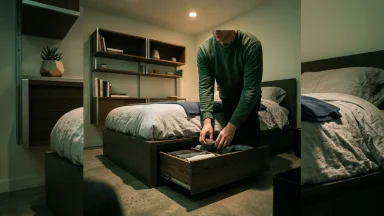
This mindset extends into every room, from tiered shelving in the bathroom to under-bed storage containers that use hydraulic lifts for easy access. By drawing the eye upward, these products create an illusion of height and openness—a welcome effect in a cramped space. The goal isn’t just to hide your clutter, but to reclaim the very volume of your home.

Tech-Integrated Solutions: The Future of Compact Home Management
Let’s be blunt: if your space-saving strategy still revolves entirely around nesting bowls and under-bed boxes, you’re missing the point. The most significant gains in small-space living aren’t happening in the hardware aisle. They’re happening in code. The true future of compact home management is about dematerialization and automation, using technology to eliminate physical clutter before it even has a chance to accumulate.
The average U.S. household now juggles around 25 connected devices, according to the Consumer Technology Association. Each one often comes with its own remote, charger, and physical footprint. Smart hubs and universal remotes are the first, most obvious step, collapsing a pile of plastic into a single interface on your phone. This isn’t just about convenience; it’s about reclaiming surfaces. What most people miss is the reduction in cognitive load—the mental energy saved when you don’t have to remember which of the five black remotes controls the soundbar.
Automated Organization: Smart Storage Systems
The next frontier moves beyond simple consolidation and into active, intelligent organization. Imagine a closet system that doesn’t just hold your clothes, but manages them. App-controlled, motorized racks can rotate your wardrobe based on the weather, bring your most-worn items to the front, or even suggest outfits. But is your apartment ready for a robotic wardrobe assistant?
Systems like these use vertical space far more efficiently than a human ever could, packing items with mechanical precision. For residents in a tiny studio, this could mean replacing a bulky dresser and a traditional closet with one sleek, automated unit. Dr. Anya Sharma, a researcher at MIT Media Lab, suggests, “We’re moving from passive storage—things sitting on a shelf—to active inventory management. Your home will know what you have and where it is, fundamentally changing your relationship with your belongings.”
Miniaturized Appliances: Power Without the Bulk
The kitchen has long been the worst offender for single-use, space-hogging gadgets. For years, the assumption was that power required size. That assumption is now obsolete. Advances in heating elements, motor efficiency, and material science mean you can get the performance of a full-sized appliance in a package that fits on a small countertop.
This is where multifunctionality shines. A single compact device can now function as a convection oven, air fryer, steamer, and microwave. It’s like trading a clunky toolbox for a sleek Swiss Army knife. You’re not just saving space; you’re simplifying the entire cooking process by reducing the number of tools you need to own, clean, and store.
Compact Kitchen Tech Essentials
The miniaturization trend extends to specialized tools that once required significant real estate. An immersion circulator for sous vide cooking, for example, is the size of a small baton yet replaces cumbersome water ovens. Similarly, compact induction cooktops offer incredible heating power and control in a slim profile that can be stored in a drawer—a turning point for anyone with limited counter space.
These devices prove that a small kitchen doesn’t have to be a limited one. By embracing these powerful, downsized tools, you can explore complex culinary techniques without sacrificing your entire prep area. Some of the most exciting developments in this area are coming from small, focused companies, and it’s worth exploring the latest culinary game changers that simplify cooking while saving space. The goal is a high-performance kitchen with a minimal physical footprint.
Ultimately, this integration of technology is creating a feedback loop. As our homes get smarter and more automated, they will begin to anticipate our needs, suggesting what to wear, what to cook, and even what to discard. Your apartment won’t just be a place you live; it will become an active partner in managing your life efficiently.
Designing for Flow: Aesthetic and Functional Space-Saving Principles
Owning the cleverest transforming furniture or the smartest home hub means little if the space itself works against you. The underlying design principles of your apartment—its color, light, and flow—are the foundation upon which all these products function. Without a solid strategy, you’re just adding well-designed clutter to a pile of existing clutter. True space optimization is a holistic approach.
Illusion of Space: Color, Light, and Mirrors
Color is your most powerful tool for manipulating perception. Lighter, neutral palettes—think soft whites, pale grays, and muted beiges—reflect more light, creating an immediate sense of openness. A study from color experts at Behr suggests that rooms painted in their “Silver Drop” shade were perceived by test subjects as up to 15% more spacious than identical rooms painted in a dark navy. This doesn’t mean you’re condemned to a world without color; use the classic 60-30-10 rule, where 60% of your room is a dominant light color, 30% is a secondary neutral, and a bold 10% is reserved for accents.
Lighting works in tandem with color to either shrink or expand your world. A single, harsh overhead fixture casts shadows and makes a room feel like a cave. Instead, think in layers: ambient (general illumination), task (for specific activities like reading), and accent (to highlight features). Wall sconces and slim floor lamps provide light without consuming valuable floor or table space, a critical factor in any small apartment.
The strategic use of mirrors is perhaps the oldest trick in the book, yet it remains undefeated. A large mirror placed opposite a window can almost double the amount of natural light in a room, and its reflection creates a profound illusion of depth. What most people miss, is that the scale of the mirror matters immensely. A collection of small mirrors often just looks like more clutter; one large, statement mirror is far more effective.
The Art of Decluttering: A Step-by-Step Guide
Before you can organize, you must simplify. Decluttering isn’t a one-time project; it’s more like tending a garden where you regularly have to pull weeds to allow your favorite plants to flourish. The data suggests the average American home contains over 300,000 items, according to the National Association of Professional Organizers (a staggering number when you think about it). So where do you even begin with a mountain like that?
You start by giving your space an honest performance review.
A systematic audit can help you move from feeling overwhelmed to being in control. Follow these steps to reclaim your space from the objects that no longer serve you:
- Assess Each Item’s Purpose: Go room by room and apply the “one-year rule.” If you haven’t used an item in the last year (seasonal items excluded), it’s a candidate for donation or disposal. This is especially true in the kitchen, where single-use gadgets accumulate. Clearing out bulky appliances to make way for streamlined tools, like some of the culinary game-changers simplifying modern cooking, is a powerful first move.
- Question Your “Just in Case” Items: We all have them—the extra cables, the clothes that might fit again someday, the box of old magazines. These items are anchors weighing down your living space. Be ruthless. The cost of replacing a cheap item if you need it in the future is often far less than the daily “cost” of living with the clutter.
- Optimize Your Layout for Flow: After purging, look at your furniture and decor. Does your layout create clear pathways? Does it block natural light? Sometimes, simply rotating a sofa 90 degrees or removing an unnecessary side table can completely change a room’s energy.
- Implement the “One In, One Out” Rule: To maintain your newly decluttered space, adopt this simple principle. For every new non-consumable item that comes into your home, one similar item must go out. This prevents the slow creep of accumulation and keeps your inventory in check.
This process of subtraction is arguably more important than any product you could add. Once your space is pared down to the essentials, you’ll find that organizing becomes intuitive. Your remaining possessions have room to breathe, and you can more clearly see where smart storage solutions or even some of the latest US-made kitchen gadgets could genuinely improve functionality rather than just add to the noise.
Ultimately, these principles of light, color, and intentional curation are about more than just aesthetics. They are about designing a lifestyle. The real goal isn’t simply a tidier apartment; it’s a clearer mind and a more deliberate way of living within your four walls, regardless of their square footage.
Beyond Products: Embracing the Space-Saving Mindset
Ultimately, the most transformative space-saving products are the ones that facilitate a deeper shift in our thinking. While a wall bed or a compact oven can physically alter a room, the real victory lies in adopting a philosophy of intentionality. It’s about viewing your home not as a static container for possessions, but as a dynamic environment that should adapt to your life—not the other way around. Each product discussed is merely a tool to serve this more conscious approach to living.
As technology and design continue to converge, our homes will likely become even more responsive and integrated. But the core challenge will remain the same: curating a space that supports our well-being and goals. So, as you consider which solutions to implement, perhaps the most important question to ask isn’t just about what to buy, but what kind of life you want to live within your walls. What if the ultimate space-saving tool isn’t a piece of furniture at all, but the discipline to ask, ‘Does this serve my life right now?’ before bringing anything new through the door?
Frequently Asked Questions
What are the most innovative space-saving products for a tiny apartment?
Some of the most innovative products include wall beds (Murphy beds) that integrate desks or sofas, console tables that expand to seat a large dinner party, and modular shelving systems that can be reconfigured to fit any nook. These pieces are designed to serve multiple functions, dramatically increasing the utility of a single room.
How can I make my small living room feel larger?
To make a small living room feel larger, focus on vertical space with tall, narrow bookshelves. Use light, neutral paint colors to reflect light and choose furniture with exposed legs to create a sense of openness. Placing a large mirror opposite a window is also a classic trick to double the perceived light and depth of the room.
Are smart furniture pieces worth the investment for small spaces?
For those committed to maximizing a small footprint, smart furniture is often worth the investment. While the initial cost can be high, the ability to make one room serve the function of two (like a bedroom and an office) can provide immense value. This versatility can even allow you to rent a smaller, less expensive apartment without sacrificing functionality.
What are common mistakes to avoid when decorating a small apartment?
Common mistakes include using furniture that is too large for the scale of the room, relying on a single harsh overhead light source, and ignoring vertical storage potential. Another frequent error is cluttering surfaces with too many small decorative items instead of using a few larger, more impactful pieces to draw the eye.
Where can I find Made in USA space-saving products?
Finding American-made space-saving products often involves looking beyond big-box stores to specialized manufacturers and boutique brands. Search online for specific terms like ‘Made in USA Murphy bed’ or ‘American-made modular shelving.’ You can also explore online directories and marketplaces that specifically feature products manufactured in the United States.